
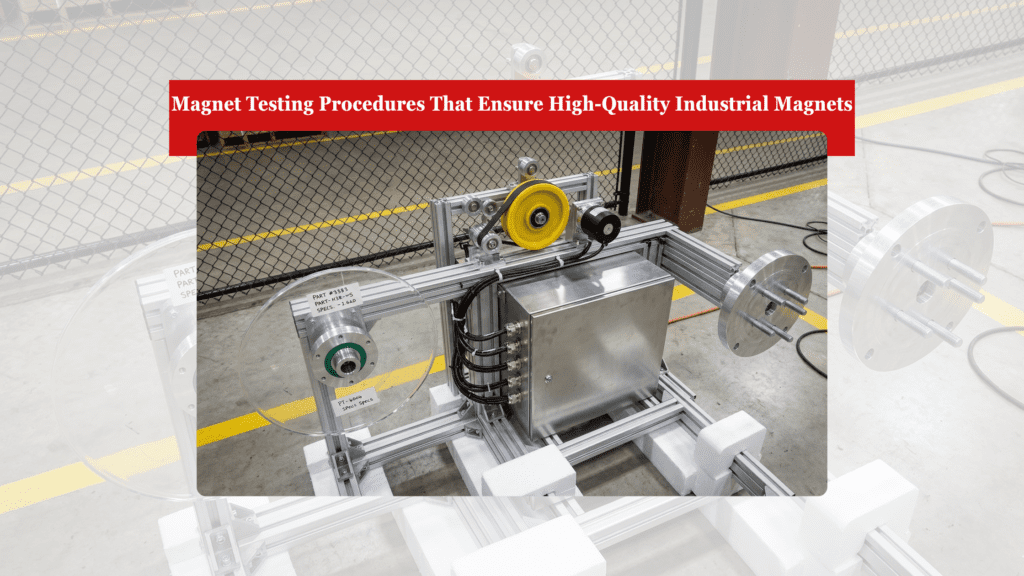
Industrial magnets are used in everything from electric motors and sensors to heavy machinery and medical equipment. Because these magnets play a critical role in performance and safety, manufacturers must ensure they meet strict quality standards.
This is where magnet testing becomes essential.
Proper magnet testing helps verify magnetic strength, durability, and reliability before the magnets are delivered to customers. Without these tests, even a small defect can cause performance issues in motors, generators, or industrial systems.
In this guide, we’ll explore the most important magnet testing procedures used by manufacturers to ensure consistent quality in industrial magnets.
Why Magnet Testing Is Important in Manufacturing
Magnets may look simple, but their performance depends on precise magnetic properties. A slight variation in magnet strength or alignment can affect the efficiency of the entire product.
Manufacturers perform magnet testing to ensure:
- Consistent magnetic field strength
- Proper magnetic flux density
- High resistance to demagnetization
- Correct dimensional accuracy
- Reliable long-term performance
Testing also helps identify defects early in the production process, reducing waste and preventing faulty magnets from reaching the market.
Key Magnet Testing Procedures Used by Manufacturers
Quality magnet manufacturers rely on multiple testing methods to evaluate the performance of permanent magnets. Each procedure focuses on a different magnetic property.
Below are the most common magnet testing procedures used in industrial production.
Magnetic Flux Density Testing
One of the most fundamental tests in magnet manufacturing is magnetic flux density testing.
This test measures the strength of the magnetic field at a specific point on the magnet. The measurement is usually expressed in Gauss or Tesla.
Manufacturers use specialized instruments such as Gauss meters to perform this test.
What This Test Confirms
- Magnetic strength of the magnet
- Uniform magnetic distribution
- Consistency between production batches
For example, magnets used in electric motors require precise flux density levels to maintain motor efficiency.
Gauss Meter Measurement
A Gauss meter test is widely used in magnet testing to measure the magnetic field at the magnet’s surface.
The device includes a probe that detects the magnetic field and converts it into readable data.
Why Gauss Meter Testing Matters
- Ensures magnets meet design specifications
- Detects weak or defective magnets
- Verifies magnetic polarity and orientation
In high-performance industries such as automotive and robotics, Gauss meter measurements are essential for maintaining consistent product performance.
Pull Force Testing
Magnetic pull force testing measures the maximum force required to separate a magnet from a steel surface.
This test helps manufacturers understand how strong the magnet will hold in real-world applications.
Key Benefits of Pull Force Testing
- Evaluates the magnet’s holding capacity
- Confirms suitability for industrial use
- Ensures reliable performance in lifting and holding applications
For instance, magnets used in magnetic separators or lifting systems must pass strict pull force tests to guarantee safety and reliability.
Demagnetization Resistance Testing
Industrial magnets must maintain their magnetic properties even under extreme conditions such as heat, vibration, or external magnetic fields.
Demagnetization testing evaluates how resistant a magnet is to losing its magnetic strength.
What This Test Measures
- Resistance to magnetic decay
- Stability under high temperatures
- Long-term durability
This test is especially important for rare earth magnets used in high-performance motors and generators.
Magnetic Flux Mapping
Flux mapping is a more advanced magnet testing method that creates a detailed map of the magnetic field distribution across the magnet.
This test helps engineers analyze how evenly the magnetic field is spread across the surface.
Why Flux Mapping Is Useful
- Detects uneven magnetization
- Identifies manufacturing defects
- Improves magnet design optimization
Flux mapping is commonly used in precision industries like aerospace and medical equipment manufacturing.
Dimensional and Visual Inspection
Besides magnetic performance, magnets must also meet strict dimensional specifications.
Manufacturers perform physical inspections to ensure:
- Correct shape and size
- Smooth surface finish
- Proper coating and corrosion protection
Even small dimensional variations can affect magnet performance in precision assemblies.
Quality Control Standards in Magnet Testing
Professional magnet manufacturers follow strict quality control standards during testing. These procedures ensure consistency across production batches.
Common quality practices include:
- Batch sampling and verification
- Calibration of testing equipment
- Documentation of test results
- Compliance with international manufacturing standards
Maintaining detailed testing records also helps manufacturers provide transparency to industrial buyers.
Practical Example: Magnet Testing in Electric Motor Manufacturing
Electric motors depend heavily on consistent magnetic performance.
Before magnets are installed in a motor rotor or stator, manufacturers typically perform:
- Flux density measurement using a Gauss meter
- Pull force verification
- Demagnetization resistance testing
These tests ensure the magnets deliver stable performance throughout the motor’s lifespan.
Without proper magnet testing, motor efficiency could drop significantly, leading to overheating or reduced operational life.
Best Practices for Reliable Magnet Testing
From years of working with magnet manufacturing processes, several best practices consistently produce better results.
Manufacturers should:
- Test magnets at multiple stages of production
- Use calibrated Gauss meters and precision instruments
- Maintain strict quality documentation
- Conduct environmental and durability tests
These steps ensure that magnets meet both performance requirements and customer expectations.
The Future of Magnet Testing
As industries such as electric vehicles, renewable energy, and robotics continue to grow, the demand for high-performance magnets is increasing rapidly.
Modern magnet testing is evolving with:
- Automated testing systems
- Digital data monitoring
- AI-assisted quality analysis
These technologies allow manufacturers to detect issues faster and maintain higher production consistency.
Trusted Magnet Testing with Permag Products
In the industrial magnet sector, reliable testing procedures are essential to ensure magnets perform consistently in demanding environments. Companies with strong engineering expertise and quality control systems are able to deliver magnets that meet strict industrial standards.
One such trusted name in the industry is Permag Products Pvt. Ltd., a leading manufacturer of magnetic equipment and industrial magnetic solutions based in India. The company provides advanced magnet testing, magnet inspection, and magnet audit services to ensure magnetic systems maintain optimal performance and reliability.
Permag offers a wide range of magnetic products designed for industrial applications, including:
- Magnetic separators
- Magnetic rods and grills
- Magnetic plates and filters
- Trap magnets and drawer separators
- Custom-designed magnetic assemblies
These solutions are widely used in industries such as food processing, pharmaceuticals, chemicals, recycling, and manufacturing to remove ferrous contamination and protect production equipment.
What makes Permag stand out is its end-to-end approach to magnetic engineering. From product design and manufacturing to testing and inspection, the company ensures every magnetic component meets strict performance standards before deployment.
With over three decades of industry experience and thousands of satisfied customers worldwide, Permag continues to support industries with high-performance magnetic solutions that improve product quality, safety, and operational efficiency.
Conclusion
Magnet testing plays a vital role in ensuring the reliability and performance of industrial magnets. From measuring magnetic flux density to evaluating pull force and demagnetization resistance, each testing method provides critical insights into magnet quality.
By following strict testing procedures and advanced quality control standards, manufacturers can deliver magnets that perform consistently in demanding applications such as electric motors, renewable energy systems, and industrial machinery.
For businesses relying on magnetic components, choosing a manufacturer with strong magnet testing capabilities ensures long-term reliability, efficiency, and product safety.
FAQs
What is magnet testing?
Magnet testing is the process of measuring and evaluating the magnetic properties of a magnet, such as field strength, flux density, and pull force, to ensure it meets quality standards.
Which instrument is used for magnet testing?
A Gauss meter is commonly used to measure magnetic field strength and magnetic flux density during magnet testing.
Why is pull force testing important?
Pull force testing helps determine the holding power of a magnet and ensures it performs reliably in lifting or holding applications.
How do manufacturers test magnet strength?
Manufacturers typically measure magnetic strength using flux density testing, Gauss meter measurements, and pull force tests.
What industries require magnet testing?
Industries such as automotive, electric motors, electronics, renewable energy, and industrial manufacturing rely heavily on accurate magnet testing to ensure product performance.